Dry Ice-Blasting
 There are various methods of media blasting, from media sand to crushed walnut shells. One of the most unique and specialized forms, though, is dry ice-blasting. While sandblasting may be one of the most effective ways to clean and smoothen rough surfaces, it can be damaging to certain surfaces and materials. On top of that, the dust left behind from sandblasting can be harmful to the lungs, and leaves behind quite a mess to clean up. Dry ice-blasting, though, is a way around many of these issues. Indeed, it is the only currently existing form of non-abrasive blasting. Here’s a little information on the uniqueness of dry ice-blasting…
How it works
Dry ice-blasting works by shooting various tiny pellets of solid CO2 at accelerated speeds. These pellets are synthetically created to be very soft. Upon impact, the sublimate almost immediately, leaving no solid mess or residue behind, besides whatever is being cleaned off of the surface. However, due to how soft they are, there is almost no friction involved in the process. Instead, the smoothing and cleaning is provided by the thousands of microscopic chemical reactions that are occur when the CO2 goes from a solid to a gaseous state so quickly. These chemical reactions cause kinetic energy in low amounts, but the frequency of the reactions happening all at once makes it very powerful.
Why to use it
The method of dry ice-blasting is good for delicate metals and materials, as little to no damage will be caused by the friction of the pellets. Dry ice-blasting can be used to clean equipment that may be flammable, as the CO2 doesn’t present a fire hazard. It is also a process that is environmentally friendlier than many other types of cleaning, which may use hazardous solvents.
Because it leaves behind no residual mess, dry-ice blasting is widely used to clean and decontaminate food processing equipment. The amount of CO2 is able to kill various bacterial organisms such as salmonella, E. coli, and listeria. Also, certain metals with complex molecular geometries can be damaged by types of abrasive blasting, but not with dry ice-blasting.
Warnings
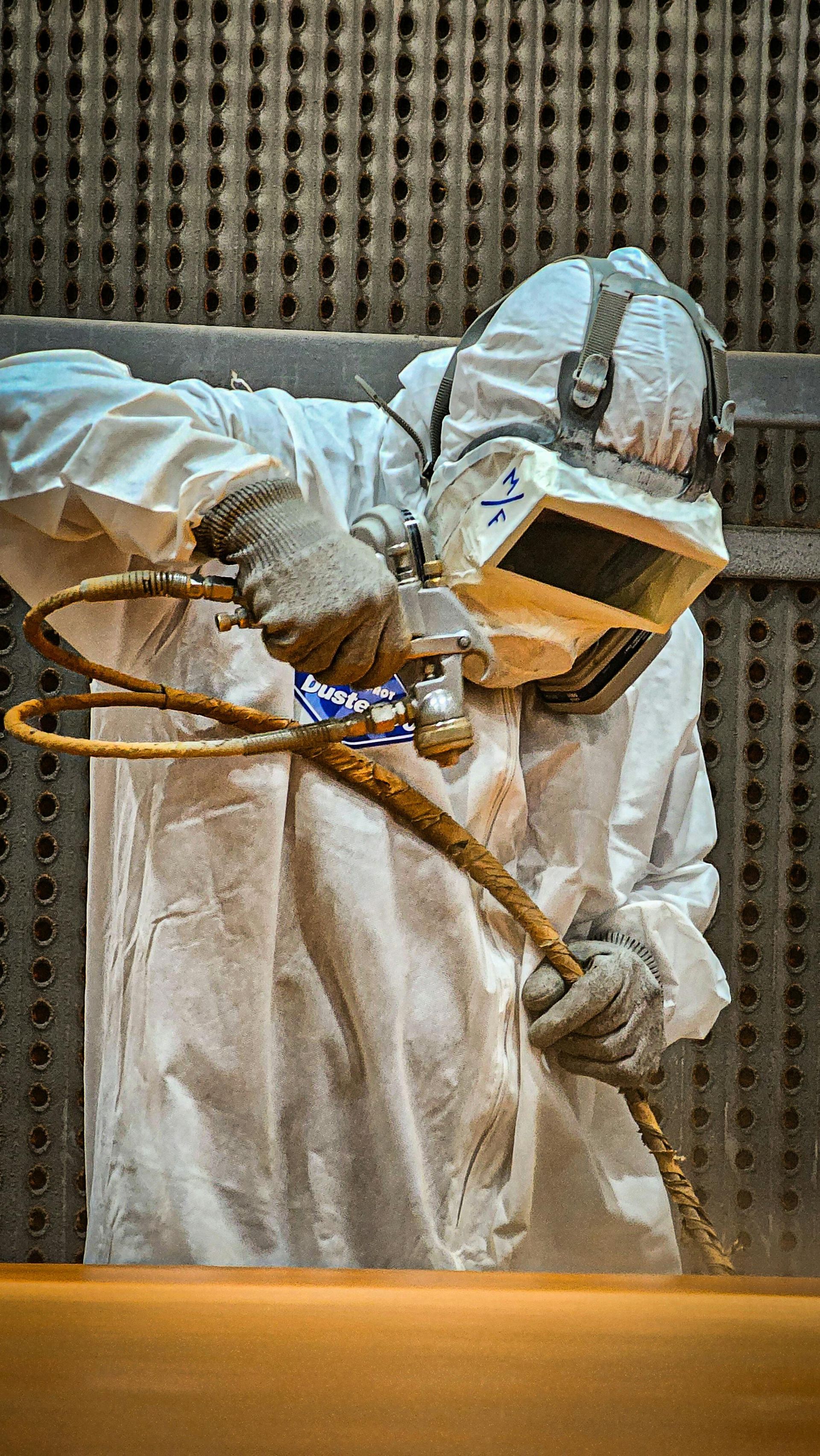
Despite the many benefits, there are still some things to be aware of when dry ice-blasting. The heavy CO2 concentration that occurs during this process displaces oxygen and can be a health hazard. For this reason, it is important to make sure that your cleaning area is heavily ventilated. All of this ventilation must be located near the ground, as well, since CO2 is heavier than oxygen. While dry ice-blasting, as with any other type of media blasting, be sure to protect your eyes, ears, and mouth while using. However, unlike many other blasting mediums, dry ice-blasting doesn’t produce any sort of toxic waste.
The post Dry Ice-Blasting appeared first on Full Blown Coatings.
Share This Post!